New Research Consortium Report Explains Why PAYERS Must Take the Lead in Changing the Way We Approach and Treat Cancer
Sep 16, 2026
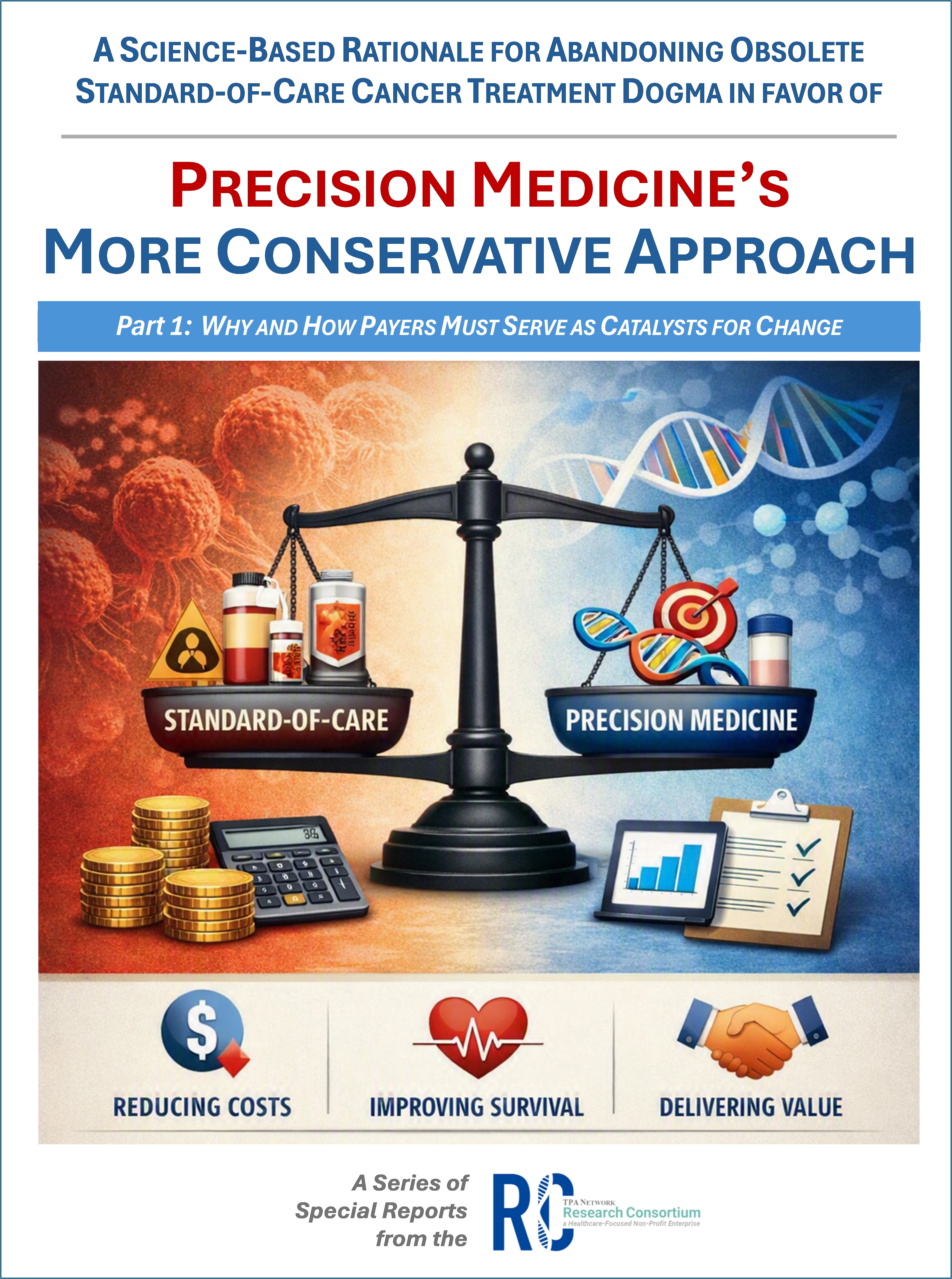
The transition from outdated, one-size-fits-all standard-of-care cancer treatment to science-based personalized care cannot be left to physicians / health systems: it must be led by payers / employer plan sponsors who make critical coverage decisions
San Diego, California Sep 15, 2026 (Issuewire.com) - A new report from the nonprofit TPA Network Research Consortium explains why health insurers must bear much of the responsibility for changing how cancer is approached and treated. The first-in-a-series report details how payers can help drive this change by following the organization's Precision Medicine Protocol, a framework for supporting a more individualized approach to cancer care.
It is possible that as many as 80% of cancer patients in the United States receive suboptimal care, in large part because of the continued reliance on organ-based, one-size-fits-all clinical guidelines that do not adequately account for the variation among individual cancers. When treatment decisions are guided by these generalized approaches rather than by the unique characteristics of each patient's cancer, patients may receive toxic, high-cost regimens that offer limited or no clinical value. Instead, treatment should be more appropriately aligned with the biology of the disease it is intended to treat.
Precision medicine integrates modern genomics into cancer care, substantially deepening our understanding of the disease and transforming how it can be treated. Rather than relying on sameness-based, standard-of-care approaches, it uses each patient's unique molecular profile to guide the selection of therapies that are biologically matched to their cancer. This approach helps identify targeted and potentially effective drugs while eliminating treatments that are unlikely to provide clinical value. By avoiding ineffective therapies, precision medicine can reduce unnecessary toxicity and improve outcomes while containing cost. It is a conservative, more cautious and science-based approach to care -- one that stands in clear contrast to blindly following obsolete, pre-genomic-era treatment dogma.
Research Consortium founder Richard Nicholas, a 48-year healthcare industry veteran, believes that payers continue to perpetuate suboptimal cancer care because they have not made a meaningful commitment to precision medicine. In his view, that commitment is essential to ensuring that cancer treatment decisions better reflect the unique characteristics of each patient's cancer.
"Organ-based cancer treatment must be superseded, as it excuses decision-making based on incomplete knowledge. By contrast, precision medicine's science-based, look-before-you-leap treatment approach is actually a more conservative course of action versus blindly following obsolete pre-genomic era dogma.
"It is high time for payers and health plan sponsors to earnestly embrace precision medicine. To do otherwise would be to continue to deny patients access to vital genomic testing and the option to try potentially viable FDA-approved cancer drugs; essentially permitting continued wasteful spending on high-cost, low-clinical-value drugs" Richard L. Nicholas
Payers' Responsibility to Advance Precision Medicine
Comprehensive health care coverage is a cornerstone of effective cancer care; and coverage decisions shape access, quality, cost, and outcomes throughout the cancer journey, influencing everything from the initiation of treatment through long-term survivorship. When coverage decisions deny, delay, or disrupt access to care, they affect not only the treatment patients receive but also the outcomes they experience. Nicholas believes that because payers make coverage decisions, much of the responsibility for driving the transition to precision medicine rests with them. He reasons that responsibility cannot rest entirely with providers and health systems, which do not control coverage determinations. Payers must therefore earnestly embrace precision medicine and support coverage decisions that advance more effective cancer care, rather than continuing to accept ineffective treatments and wasteful spending on them.
A Practical Framework for Advancing Precision Medicine
To help health insurers and self-funded employers drive meaningful change, the nonprofit Research Consortium created a Precision Medicine Protocol as a practical framework for supporting more effective, individualized cancer care. This report, the first in a series on precision medicine, describes the protocol and explains how and why payers can support its use. It also examines how payers can promote cancer care that is better aligned with individual patient needs while addressing the quality, cost, and value considerations that shape coverage decisions. Later installments in the series will provide additional detail about the protocol, challenge conventional thinking about the cost and value of combination drug treatments and show payers how to gain greater control over oncology specialty-drug spending.
The report is available for download here.
Should you wish to learn more about how you can support our work, please click on this link to our new fundraising campaign, Advancing Personalized Cancer Care. Cancer patients everywhere will be glad you did.
About the TPA Network Research Consortium
The TPA Network Research Consortium is a non-profit, industry-wide healthcare research initiative that helps providers evaluate and assess new medical technologies and innovations, plan participants obtain leading-edge healthcare, scientists advance medical research, and payers reduce risk ... by conducting payer-focused translational research, in real-world settings. Visit ResearchConsortium.org
Media Contact
TPA Network Research Consortium, Ltd.
8583954114
555 Saturn Blvd, Suite B408
Source :TPA NETWORK RESEARCH CONSORTIUM LIMITED
This article was originally published by IssueWire. Read the original article here.






















YOUR NEWS, OUR NETWORK.
Do you have Great News you want to tell the world?
Be it updates about your business or your community, you can make sure that it’s heard by submitting your story to our network reaching hundreds of news sites across 6 verticals.
About Us
Recent Discovery will take you to the captivating developments in science, technology, and the universe around us. We deliver to you the latest news, theories, and developments in the world of science.
News